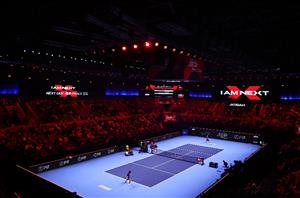

ATP Next Gen Finals 2025 Final Preview: Learner Tien vs Alexander Blockx
23 Dec 2025
Read More
ATP Adjusts Rankings, Heat Policy, and Finals Race for 2026
- ATP reduces ranked events from 19 to 18 for 2026
- New rule: Top-30 players require fewer ATP 500 commitments
- Extreme heat policy introduced for enhanced player safety
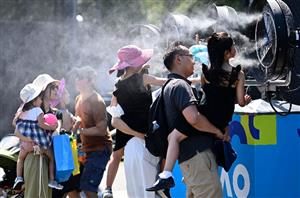
A family cool off from the heat in front of mist cooling fans at the Melbourne Park ahead of the Australian Open tennis tournament in Melbourne.
(credit: Getty)
- Rankings System Update: From 19 Events to 18
- Top-30 Relief: Fewer 500s Required
- Missed Masters Protection: Smarter Drop Rules
- Race to the ATP Finals: Paris Is the Cut-Off
- Extreme Heat Rule Introduced for Player Safety
- Calendar and Format Tweaks for 2026
Taken together, the changes signal a more controlled and centralized approach to competition. The rankings formula has been simplified. Obligations for elite players have been adjusted. Clear thresholds have been introduced for extreme weather. The Race to the ATP Finals has been tightened to better reflect performance across the core season rather than opportunistic late entries.
What follows is a clear look at what is changing, why the ATP felt compelled to act, and how the new framework is likely to affect players across different tiers of the tour.
Rankings System Update: From 19 Events to 18
Beginning in 2026, the ATP will calculate rankings using results from 18 tournaments rather than 19. The Year-End Championships will continue to count toward that total.
What changes
Under the current framework, a player’s best 19 results are included in the rankings calculation. From next season, that number will drop to 18, with no change to the status of the ATP Finals within the formula.
Why it matters
The adjustment is modest but meaningful. Reducing the number of counted events eases cumulative schedule pressure, particularly for players who advance deep into tournaments week after week while also managing injuries and mandatory commitments. One fewer result in the calculation provides greater flexibility, allowing top players to rest or skip select events with less immediate impact on their ranking position.
ATP Rankings Calculation: Old vs New
| Category | Previous System | New System (from 2026) |
|---|---|---|
|
Ranking events counted |
Best 19 results |
Best 18 results |
|
Year-End Championships |
Included |
Included |
|
Margin for skipped events |
Limited |
Slightly increased |
|
Scheduling flexibility |
Tighter |
More accommodating |
Top-30 Relief: Fewer 500s Required
The ATP has also adjusted the obligations placed on its highest-ranked players at the end of the season.
Old rule
Players finishing the year inside the top 30 were required to count results from five ATP 500 tournaments, including mandatory Masters 1000 events, to avoid zero-point penalties in their rankings total.
New rule from 2026
That requirement has been reduced to four 500-level events.
Impact
The change reflects the growing congestion of the calendar and the cumulative physical strain faced by the game’s elite. It also curtails a familiar pattern in which top players entered ATP 500 events primarily to protect ranking points rather than to pursue form, preparation, or competitive priorities.
Top-30 ATP 500 Requirement: Old vs New
| Category | Old Rule | New Rule (2026) |
|---|---|---|
|
ATP 500 results required (Top 30) |
Five |
Four |
|
Zero-point penalties |
Applied below threshold |
Threshold lowered |
|
Mandatory Masters counted |
Yes |
Yes |
Missed Masters Protection: Smarter Drop Rules
The ATP has introduced a more flexible mechanism to address prolonged absences from its biggest mandatory events.
Key adjustment
Players who miss two or more consecutive Masters 1000 tournaments will be permitted to replace up to three zero-point results using performances from subsequent ATP 500 or ATP 250 events.
Why this matters
Under the previous framework, injuries or unavoidable absences at the Masters level often produced ranking distortions that persisted long after a player returned to competition. The revised rule provides a measured safety valve, offering relief in exceptional circumstances while preserving the central importance of the Masters 1000 tier within the ranking structure.
Masters 1000 Absence Replacement Rule: Summary
| Aspect | Previous Rule | New Rule (2026) |
|---|---|---|
|
Consecutive Masters missed |
No structured relief |
Relief after two or more missed |
|
Zero-point replacements |
Not permitted |
Up to three allowed |
|
Eligible replacement events |
Not applicable |
ATP 500 and ATP 250 |
|
Impact on Masters status |
N/A |
Importance preserved |
Race to the ATP Finals: Paris Is the Cut-Off
The ATP has formally tightened the qualification window for its season-ending championship.
New Race rule
From 2026, the Race to the ATP Finals will conclude with the Paris Masters. Points earned at tournaments staged after Paris, including events such as Stockholm and Athens, will be applied to the following season’s Race rather than the current one. The ATP Finals remain the final championship of the year.
What this fixes
In recent seasons, late-calendar ATP 250 events had created a narrow but meaningful opening for players to move into contention after much of the elite field had already closed its season. By drawing a clear line at Paris, the ATP restores competitive balance and ensures that qualification is determined by performance across the main competitive arc of the season, rather than by late opportunities on a reduced field.
Race to the ATP Finals Qualification Window: New Framework
| Item | Previous Approach | New Rule (from 2026) |
|---|---|---|
|
Race cut-off point |
Extended beyond Paris |
Ends after Paris Masters |
|
Post-Paris tournaments |
Counted for current Race |
Shifted to following season |
|
Examples affected |
Stockholm, Athens |
Applied to 2027 Race |
|
Season finale |
ATP Finals |
ATP Finals |
Extreme Heat Rule Introduced for Player Safety
Player welfare takes a more concrete and standardized step forward with the introduction of a formal extreme-heat policy.
How it works
- From 2026, the ATP will rely on Wet Bulb Globe Temperature readings to govern on-court heat responses.
- At 30.1°C WBGT, a single 10-minute cooling break will be permitted after the second set.
- When WBGT readings rise above 32.2°C, play in best-of-three singles matches will be suspended.
Why it matters
Unlike simple air temperature readings, WBGT accounts for humidity, radiant heat, and airflow, offering a more accurate assessment of physiological stress on court. The shift aligns ATP policy with established standards used across other global sports and replaces discretionary heat responses with clear, enforceable thresholds.
ATP Extreme Heat Protocol: WBGT Thresholds
| WBGT Reading | Measure Applied |
|---|---|
|
30.1°C |
One 10-minute cooling break after the second set |
|
Above 32.2°C |
Suspension of play in best-of-three singles |
Calendar and Format Tweaks for 2026
The ATP has confirmed a series of smaller but telling adjustments to the structure and presentation of the tour.
Global footprint
The 2026 calendar will feature 59 tournaments across 29 countries, in addition to the four Grand Slams. The scale reflects the ATP’s continued geographic reach while preserving a broadly balanced distribution of playing surfaces.
Next Gen ATP Finals
A formal bidding process has been opened for future hosts of the Next Gen ATP Finals, underscoring the event’s rising commercial profile and its growing role in player development pathways.
Mixed doubles update
Mixed doubles matches will now include one team timeout per match. The change is designed to improve match flow, enhance clarity for players and officials, and introduce a modest tactical element without disrupting the format.
Latest News
-
 Next Gen Final
 -
Alcaraz–Ferrero SplitCarlos Alcaraz and Juan Carlos Ferrero Split in Shock Coaching Break Ahead of 2026 Season23 Dec 2025 Read More
-
Djokovic Sends WarningWarning From Novak Djokovic to the Rest of the Tour Ahead of the 2026 Season23 Dec 2025 Read More
-
Tien Leads Next GenATP Next Gen Finals 2025 Preview: Is Learner Tien the Man to Beat?23 Dec 2025 Read More