
Coco Gauff: Power, Poise, and a New American Era
16 Dec 2025
Read More
Carlos Alcaraz: Background, Rise & Playing Style
- Carlos Alcaraz, a Spanish tennis prodigy, mixes power with creative play
- He turned pro early and focused on professional competition over junior titles
- Alcaraz, a Grand Slam winner, leads the post-Big Three tennis era
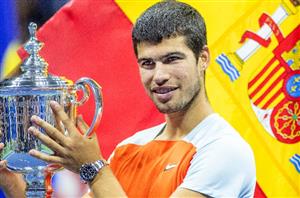
Carlos Alcaraz with the US Open trophy, a symbol of his rapid rise from Murcia prospect to global force in men’s tennis.
(credit: Getty)
- Roots in Murcia
- Growing Up on Court
- A Junior Career Without the Spotlight
- Turning Pro Early
- Breakthrough on the Big Stage
- Playing Style and Competitive Identity
- Personality and Public Image
What separates Alcaraz is how naturally he mixes power with variety. He can trade heavy from the baseline, sprint forward to finish at the net, or drop-shot you into confusion without breaking rhythm. The athleticism is obvious, but it is the fearlessness that defines him. He is comfortable changing gears mid-rally, taking risks on big points, and trusting his instincts even under pressure.
Already a multiple Grand Slam champion and a former world No. 1, Alcaraz is not framed as a future star so much as a present one. He is widely seen as the player most likely to carry men’s tennis forward in the post Big Three era, not just because he wins, but because of how he wins. His game is built for highlight reels, but it holds up just as well when the stakes are highest, which is why his rise has felt as inevitable as it has been exciting.
Roots in Murcia
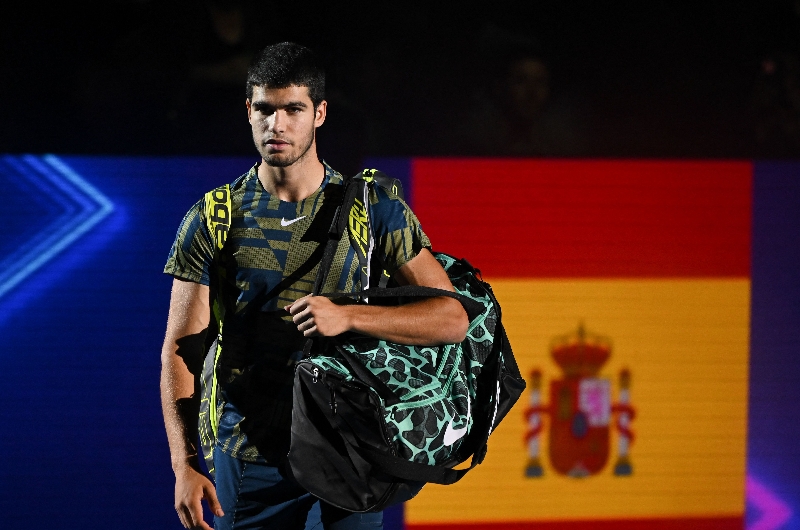
He is the second of four brothers, Álvaro, Sergio, and Jaime, all of whom have been involved in tennis in different ways. Much of Alcaraz’s childhood was spent at the Real Sociedad Club de Campo de Murcia, where his father worked. Being surrounded by courts from such an early age gave him constant access to hitting partners, many of them older and stronger, and immersed him in the routines and competitive rhythms of Spanish tennis culture long before he was old enough to compete seriously.
Growing Up on Court
Carlos Alcaraz started playing tennis around the age of four, essentially growing up on court and hitting balls as soon as he could hold a racket. Football was part of his early sporting life, as it is for most kids in Spain, but tennis quickly moved to the front. The combination of natural coordination, a strong competitive streak, and constant access to courts made the decision feel almost automatic rather than forced.
As his level pushed beyond local competition, his path became more structured. He came under the guidance of Albert Molina, who helped connect him with IMG and put a long-term professional development plan in place. That support brought clarity early, turning raw talent into something deliberately shaped rather than rushed.
The defining move came when Alcaraz joined the academy of former world No. 1 Juan Carlos Ferrero in Villena. Living and training in a fully professional environment as a young teenager accelerated everything. The tennis improved quickly, but just as importantly, so did the discipline, routines, and maturity required to survive at the top level. That period marked the moment when Alcaraz stopped being a gifted junior and started being built, deliberately, for the professional tour.
A Junior Career Without the Spotlight
Carlos Alcaraz's the junior phase was never about headlines or chasing a No. 1 junior ranking. He competed on the ITF Junior Circuit, but his team made a clear choice not to build his profile around junior Grand Slam titles or year-end junior standings. The results were solid, sometimes very good, but never pushed for maximum exposure. That was by design, not a limitation.
From his mid-teens, the emphasis shifted toward professional competition. Futures and Challenger events became the priority, with a deliberately lighter junior schedule. Compared to peers who stacked junior trophies, this approach generated far less early hype. To many fans, his arrival at ATP level later on felt sudden, almost out of nowhere.
In reality, Alcaraz had been testing himself against grown professionals from as early as 14 or 15. He was learning how to handle heavier balls, stronger bodies, and the weekly grind of men’s tennis long before the spotlight arrived. That early exposure flattened the learning curve, and when his results finally broke through on the main tour, they looked explosive only because most people had not been watching the groundwork being laid.
Turning Pro Early
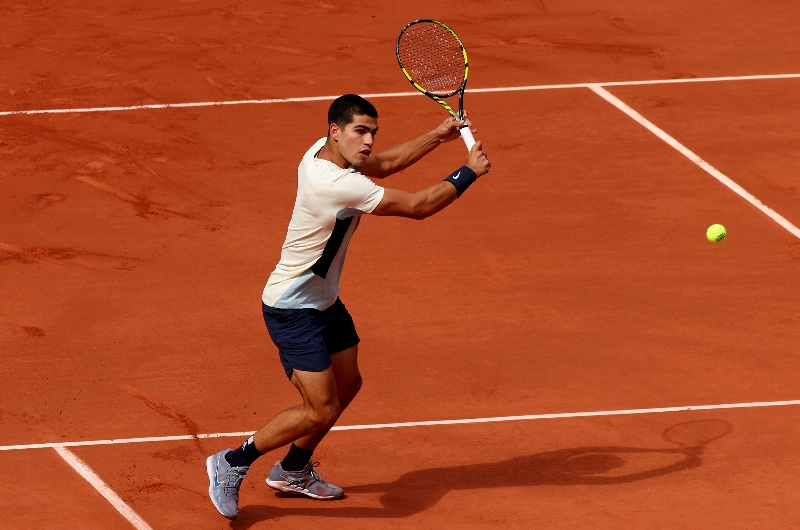
Across 2019 and 2020, his schedule was carefully balanced between Futures and lower-tier Challenger events. There was no rush, just steady match volume and constant exposure to stronger, more experienced opponents. Each stretch added layers to his game, physically and tactically, while quietly pushing his ranking forward.
His first ATP Tour main-draw appearance came in 2020 at the Rio Open, where a wildcard opportunity turned into a statement win over Albert Ramos-Viñolas. By May 2021, shortly after lifting a Challenger title in Oeiras Challenger, Alcaraz had broken into the top 100. From that point on, his presence on the main tour felt natural rather than accelerated, the result of years spent building his game against adult competition rather than chasing early recognition.
Breakthrough on the Big Stage
The moment Carlos Alcaraz truly announced himself to the wider tennis world came at the US Open in 2021. That quarterfinal run changed the conversation, especially the five-set upset of Stefanos Tsitsipas, where Alcaraz did not just survive the stage but embraced it. Overnight, he stopped being framed as an exciting teenager and started being viewed as a genuine future Slam threat.
A year later, he removed any remaining doubt. In 2022, he went all the way in New York, lifting the title and becoming the youngest world No. 1 in ATP history after beating Casper Ruud in the final. What followed only strengthened the narrative. More Slam titles, Masters trophies, and statement wins against players like Novak Djokovic made it clear this was not a hot streak or a perfect season. It was the base layer of a career built to define an era, combining results, resilience, and a style that holds up when the stakes are at their highest.
Playing Style and Competitive Identity
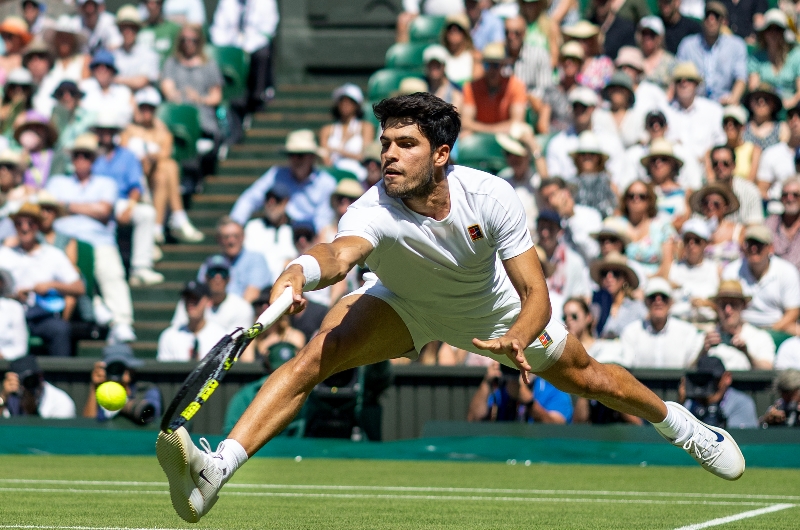
At heart, Carlos Alcaraz plays an aggressive, all-court brand of tennis that feels deliberately unpredictable. He is happy to trade heavy, topspin-loaded shots from the baseline, but just as comfortable breaking rhythm by moving forward, throwing in drop shots, or finishing points at the net. It is modern power tennis layered with a very Spanish sense of creativity and instinct.
The forehand is the engine. It comes with extreme racket-head speed and heavy spin, but what really separates it is its flexibility. He can roll it high, flatten it out through the court, or carve sharp angles depending on the situation. The backhand plays a different role. It is not always about outright damage, but about control. He uses it to change direction, set up the forehand, or absorb and redirect pace when rallies turn physical.
Everything is supported by elite movement. Alcaraz slides naturally even on hard courts, defends comfortably from deep positions, and can turn defense into attack in a single shot. Comparisons to peak Novak Djokovic and Rafael Nadal come up often, largely because of that blend of athleticism and resilience. What makes him different is his willingness to improvise. In pressure moments, he has openly said his instinct is to keep going for his shots rather than pulling back. That commitment to aggression gives him an enormous ceiling, and a game that holds up across clay, grass, and hard courts alike.
Personality and Public Image
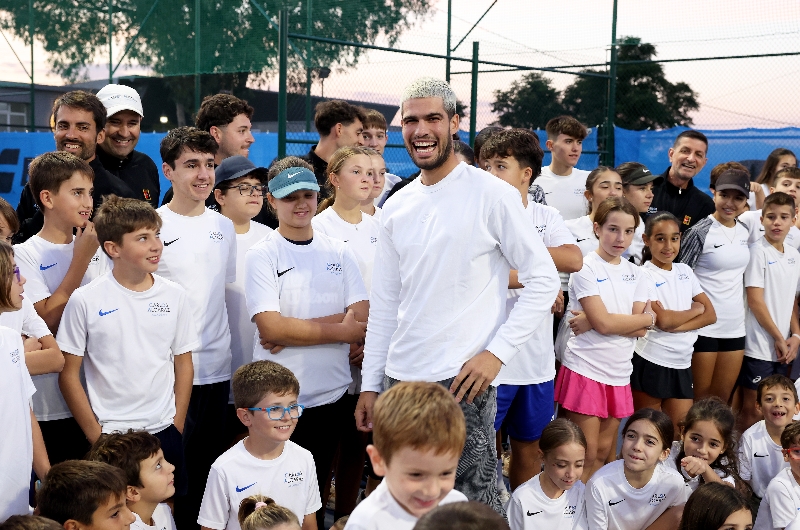
Off the court, that openness carries through. He comes across as relaxed and good-humoured, quick to credit opponents and often talking about joy in competition alongside ambition. There is confidence, but very little edge or aloofness. Even after big wins, the tone is usually grounded, focused on the process rather than the moment.
Latest News
-
 Coco Gauff Profile
 -
Novak Djokovic ProfileNovak Djokovic: Anatomy of the Most Complete Player in Tennis16 Dec 2025 Read More
-
Sabalenka ProfileAryna Sabalenka: The Making of a Powerhouse16 Dec 2025 Read More
-
Iga Swiatek ProfileIga Swiatek: From Warsaw to WTA Dominance16 Dec 2025 Read More