
Coco Gauff: Power, Poise, and a New American Era
16 Dec 2025
Read More
Novak Djokovic: Anatomy of the Most Complete Player in Tennis
- Djokovic's resilience stems from his challenging early life in Belgrade
- Focused on professional levels early, he became an elite player by 2007
- His adaptable playing style and mental toughness define his on-court success

Fans celebrate Novak Djokovic’s record-setting achievements, reflecting his status as one of the most dominant and polarizing figures in modern tennis.
(credit: Getty)
- Early Life and Background
- First Steps in Tennis
- A Junior Career with a Professional Focus
- Turning Professional
- Breakthrough to the Elite
- Playing Style and Identity
- Personality and Public Image
A multiple-time year-end world No. 1 and record-setting Grand Slam champion, Djokovic’s dominance has never been about overwhelming power or stylistic flash. It has been built on adaptability, physical durability, and an extraordinary capacity to absorb pressure and turn it back on opponents. Match by match, era by era, his greatness has been shaped by longevity, precision, and an unmatched ability to find answers when others run out of options.
Early Life and Background
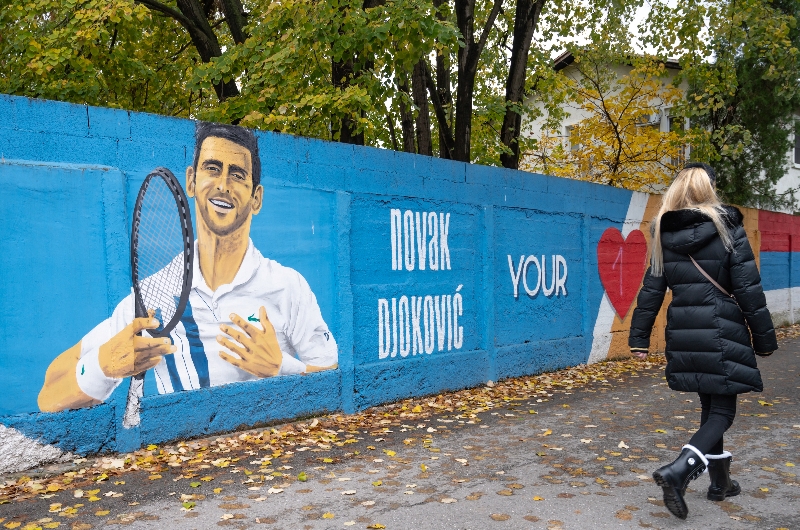
Djokovic first picked up a tennis racket at the age of four, and his talent was spotted almost immediately by former Yugoslav player and highly regarded coach Jelena Gencic. She became his first major mentor and was struck not just by his skill, but by his focus and seriousness. Gencic later spoke of his unusual discipline and competitive drive, traits that stood out even among gifted children.
His formative years were shaped by instability and hardship. Djokovic grew up during the Yugoslav wars and lived through the 1999 NATO bombing of Belgrade, often spending nights in bomb shelters. Those experiences left a deep mark. He has frequently spoken about how that period gave him perspective, resilience, and an early understanding that progress rarely comes without struggle. That mindset, forged long before professional tennis, would later become one of the defining pillars of his career.
First Steps in Tennis
Under the guidance of Jelena Gencic, Novak Djokovic trained systematically in Belgrade from roughly the ages of six to twelve. Those years were about fundamentals and understanding, not shortcuts. He built clean technique, learned how to construct points properly, and developed an unusually advanced sense of tactics for someone so young. Even then, he was known for his obsessive attention to detail, intense practice habits, and a willingness to repeat drills endlessly until they felt right.
Financial pressure was never far away. His family invested heavily in his development despite limited resources, often stretching themselves to make training and travel possible. Tennis was not just a passion, but a potential path forward in an uncertain national environment. That early mix of structure, sacrifice, and ambition shaped Djokovic’s competitive identity, teaching him from the start that progress came through discipline, patience, and a refusal to waste effort.
A Junior Career with a Professional Focus
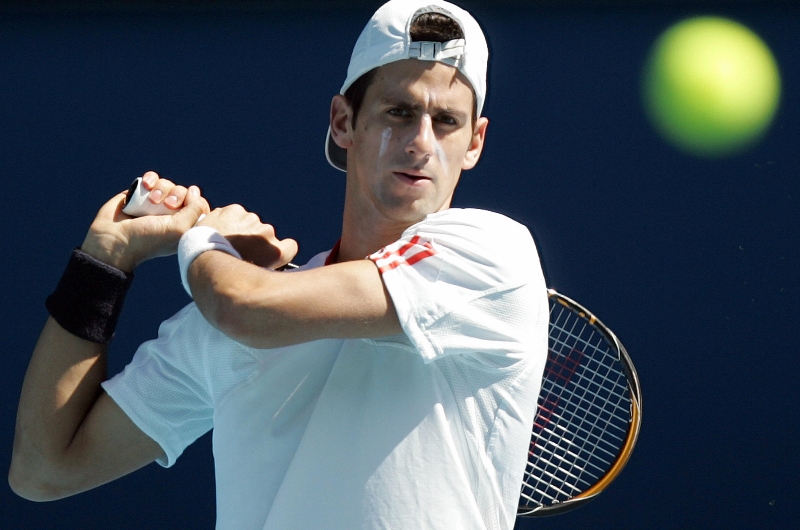
From his mid-teens, the emphasis shifted decisively toward professional competition. Rather than chasing junior prestige, Djokovic began prioritising Futures and Challenger events, testing himself against older, physically mature opponents. That choice signaled an early commitment to the professional grind, valuing match toughness and adaptation over junior accolades. It was a clear indication that his team viewed long-term readiness for the tour as more important than short-term junior success.
Turning Professional
Around the age of 13, Novak Djokovic left Serbia to train at Niki Pilić’s academy in Munich, a move designed to expose him to higher-level coaching and stronger competition. It was a significant step, both technically and personally, and one that signaled a clear commitment to a professional future. Between 2001 and 2003, he began entering professional events regularly, officially turning pro in 2003.
The early progress was methodical rather than explosive. Djokovic worked his way through ITF Futures and ATP Challenger tournaments, learning the rhythms of the tour and building his ranking piece by piece. His first Challenger title came in 2004, an important milestone that opened the door to ATP qualifying draws and more consistent opportunities at tour level.
By 2005, he had broken into the top 100, and the rise continued steadily rather than dramatically. Over the next season, he pushed into the top 20, establishing himself as more than a promising newcomer. At that point, Djokovic was already known as a reliable, mentally tough competitor on tour, someone whose results were built on consistency, endurance, and an ability to learn quickly from higher-level opposition.
Breakthrough to the Elite

His first Grand Slam title followed at the Australian Open in 2008, a moment that formally announced his arrival among the elite. That win established credibility, but the true transformation came a few years later. In 2011, Djokovic produced one of the most dominant seasons in tennis history, repeatedly beating both Federer and Nadal, collecting multiple major titles, and reshaping the competitive hierarchy of the sport. From that point on, he was no longer chasing greatness. He was redefining it, shifting from elite contender to an all-time force at the centre of men’s tennis.
Playing Style and Identity
At the core of Novak Djokovic’s game is what many consider the greatest return of serve in tennis history. His anticipation, balance, and flexibility consistently neutralise elite servers, turning their biggest weapon into a rally rather than an advantage.
From the baseline, he combines elasticity with precision. The two-handed backhand is one of the most reliable shots ever produced, able to absorb pace, redirect cleanly, or open angles under pressure. The forehand has evolved into a versatile weapon, capable of heavy spin or flatter aggression when required.
Movement is central to his dominance. Sliding on hard courts and clay, deep splits, and exceptional recovery speed make the court feel smaller for opponents and allow him to flip defense into offense seamlessly.
The serve, once a relative weakness, became a strength through technical refinement, adding free points and greater control over service games. Mentally, Djokovic is defined by resilience in big moments, supported by meticulous attention to preparation, recovery, and wellness, including a famously disciplined approach to diet and mental training.
Personality and Public Image
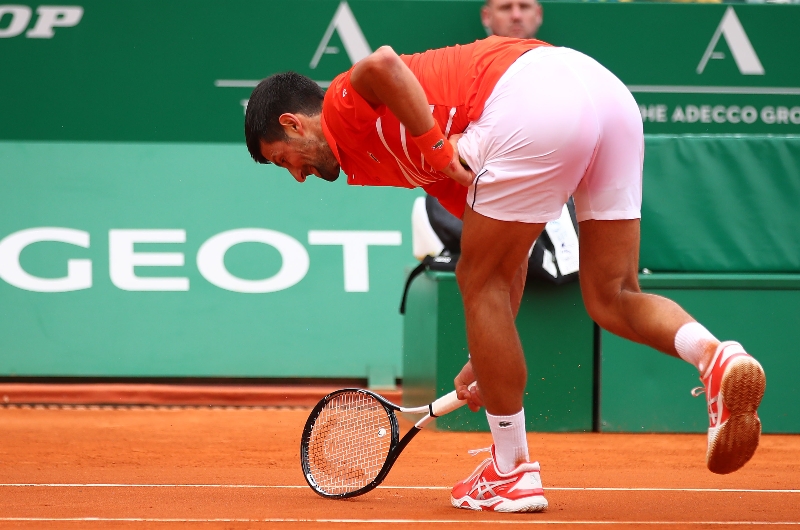
Public perception has often been layered. Djokovic is universally respected for his excellence, longevity, and professionalism, yet he has remained a polarising figure. Controversies, strong personal views, and a consistent willingness to challenge governing bodies and conventional wisdom have kept him at the centre of debate as much as admiration.
He has always presented himself as independent-minded, comfortable questioning mainstream narratives and trusting his own judgment. Away from the court, he is closely linked with philanthropy through the Novak Djokovic Foundation and frequently speaks about family as his anchor. His wife, Jelena Djokovic, and their children are often cited as central motivations, grounding his career in something larger than tennis alone.
Latest News
-
 Coco Gauff Profile
 -
Sabalenka ProfileAryna Sabalenka: The Making of a Powerhouse16 Dec 2025 Read More
-
Iga Swiatek ProfileIga Swiatek: From Warsaw to WTA Dominance16 Dec 2025 Read More
-
Carlos Alcaraz ProfileCarlos Alcaraz: Background, Rise & Playing Style15 Dec 2025 Read More